For platform and cloud-security teams
Explain cloud access. Put accountable owners behind the next decision.
Chamber brings Terraform context, supported observed-cloud evidence, identities, and ownership together so teams can explain effective access, govern the next decision, and carry supported changes through the customer's own Terraform pipeline.
Cloud infrastructure access intelligence and governance
The access decision needs more than one policy file.
- What access exists?
- Understand the effective outcome for a resource, human, or workload identity within Chamber’s current evidence coverage.
- Why does it exist?
- Keep representative paths and provenance beside the outcome they explain.
- Who decides what changes?
- Attach the decision to accountable chamber owners and preserve Primary fallback responsibility.
See the evidence and the decision together.
These captures come from Chamber's deterministic sample organization and the same accepted product journeys used for local verification.
Sample organization
Explain an access path
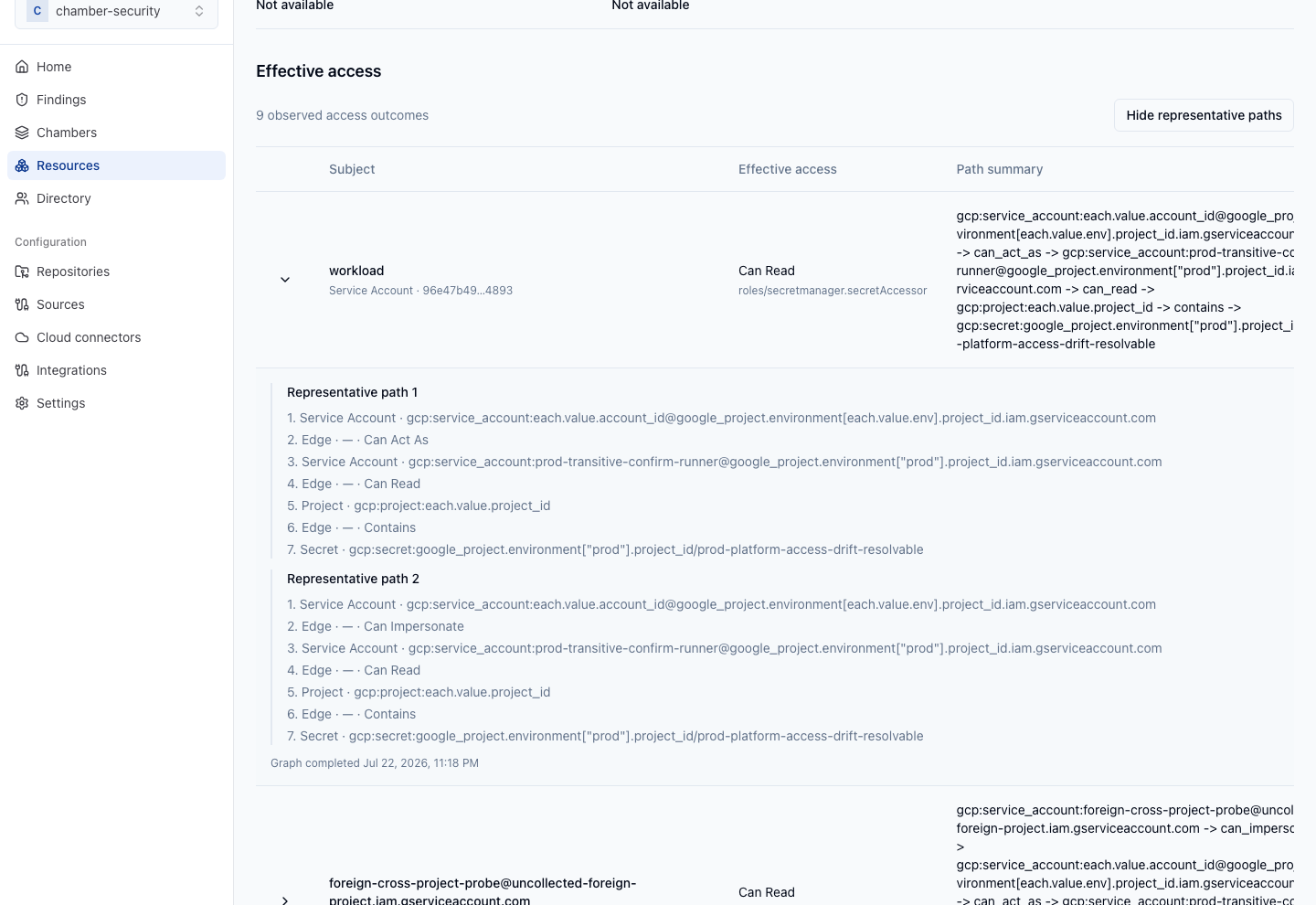
A resource detail keeps the observed outcome, path summary, representative graph steps, and chamber context together.
- Observed outcome
- Can Read
- Representative paths
- 2 shown
- Current sample scope
- 9 observed access outcomes
Representative paths within current provider and evidence coverage; the display does not claim to enumerate every possible path.
Open full-size proof (opens in a new tab)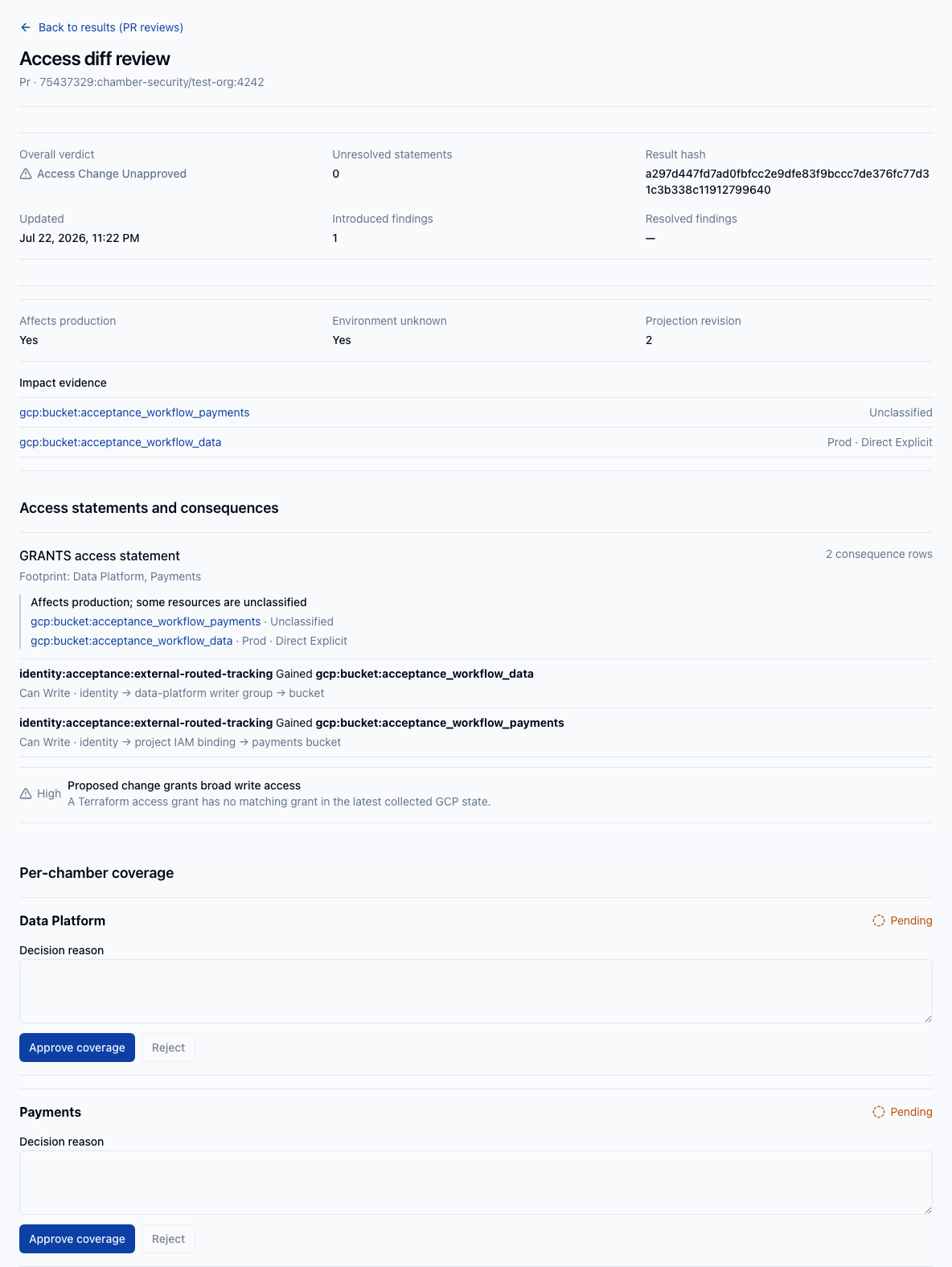
Sample organization
Govern the affected boundary
A review relates the proposed access consequence to its Data Platform and Payments footprint and records a decision for each chamber.
- Access consequences
- 2 Can Write rows
- Affected chambers
- Data Platform, Payments
- Coverage state
- Pending for both
Chamber coverage is separate from GitHub code review, branch protection, and merge authority.
Open full-size proof (opens in a new tab)How Chamber works
Evidence constrains the action; accountable authority constrains the decision.
- 01
Observe
IaC, supported cloud connectors, identities, and ownership context.
- 02
Explain
Effective-access outcomes, representative paths, and provenance within current coverage.
- 03
Govern
Expose the affected chamber footprint and record decisions from accountable owners; GitHub review and merge authority remain separate.
- 04
Act and verify
For supported work, carry the authorized change through the customer's Terraform repository and wait for later observation to confirm the result.
Follow the access question to a governed outcome.
- 01
Investigate unexpected access
Start from a resource or identity and inspect the current outcome, representative paths, provenance, and ownership context.
Product detail - 02
Govern an access change before merge
Inspect the access delta, identify the affected chamber boundaries, and record Chamber coverage decisions independently of repository review and merge authority.
Product detail - 03
Remediate supported work through Terraform
Preview and authorize an exact supported plan, follow the Terraform pull request, and close only when later evidence confirms the intended outcome.
Product detail
Customer control stays explicit.
These boundaries are part of the product model, not a hidden disclaimer.
- Chamber explains access within current provider and evidence coverage.
- Displayed paths are deterministic representatives, not a claim of exhaustive path enumeration.
- Chamber coverage decisions do not replace GitHub review or merge authority.
- Chamber does not operate the customer's Terraform state backend, run terraform apply, or own customer CI/CD.
- Unsupported work remains explicit and is routed outside Chamber automation.
Inputs stay connected to their source.
- GitHub repositories
- Repository grants and source analysis for the Terraform Chamber can observe.
- Supported cloud connectors
- Supported AWS and Google Cloud connectors add observed evidence beyond code.
- Directory feeds
- Optional identity and group feeds extend the context behind access and ownership.
Bring a real access path to the conversation.
A walkthrough will trace the evidence, identify the accountable boundary, and show the supported next step.